By ilovetoeatspicy editorial team · Updated
Quiet Games for Couples
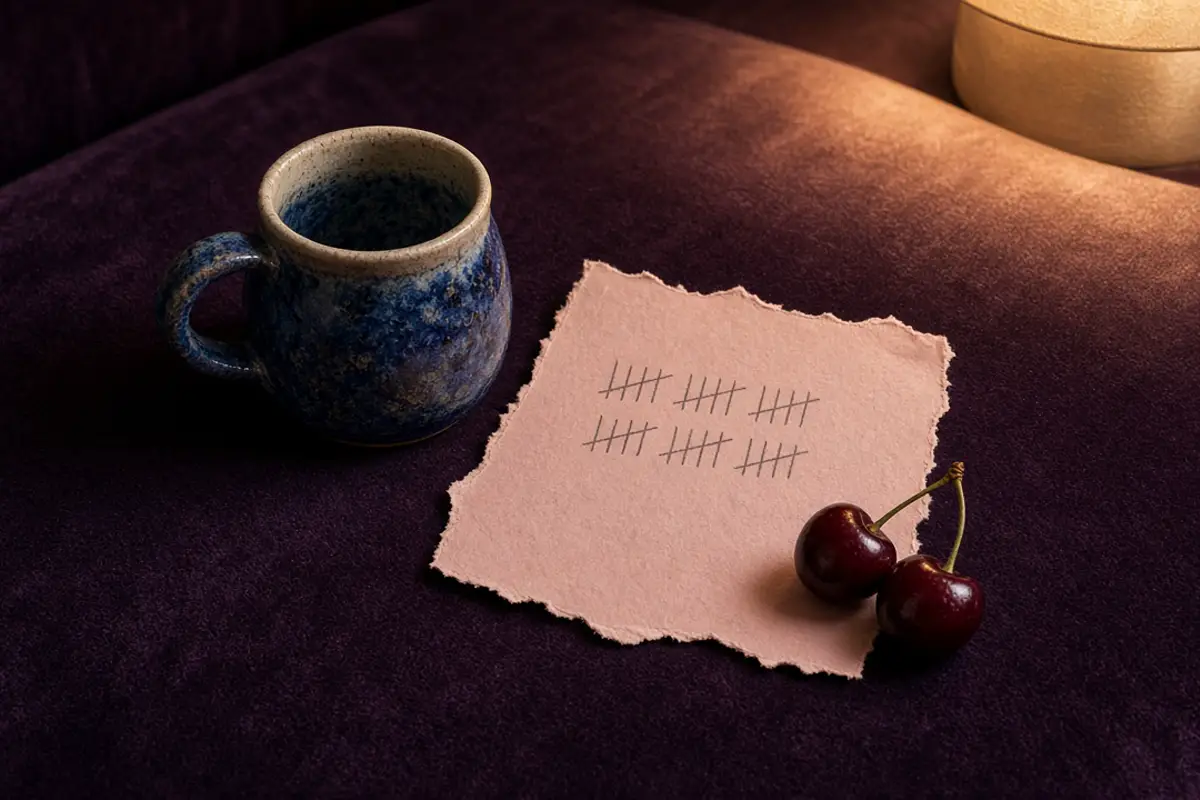
Two tired people, already sitting down, about 15 to 20 minutes. This page is an editorial house-rule format for a quiet, low-energy session. Stay seated the whole time. Keep an indoor voice, the kind you would use late at night, with thin walls, or in a shared apartment. Use only what is already within arm's reach.
It is still a game session: three short games, a stop, and a round tracker. It is not a rest-only date, and it is not a picnic. It is not the official rules of any branded or published game.
Setup for a 15 to 20 minute session
Plan about 15 to 20 minutes, including the minute you spend agreeing how to stop. That length is our suggestion for tonight, not a measured ideal. Either person can stop sooner.
Where you sit. Pick the seats you will keep: a sofa, two chairs, or the edge of the bed. You do not get up to fetch a prop, to check an object, or to make the game bigger. If you cannot see something from the seat, it is not a target in this session.
The clock. Before game 1, name a stop time about 15 to 20 minutes away, or agree to stop after game 2 if energy drops. When that time arrives, finish the turn you are on and stop. A second session needs a new yes from both people.
Phones. Put phones face down. One phone may be a silent timer: set it, turn the sound off, then place it face down. Do not open an app for this session. Do not pick a phone up to read a message during a turn. No signup and no purchase.
What you already have. A mug, a lamp, a window, a table within reach. That is enough. You do not need a deck, a printed sheet, a special object, or anything bought for tonight. Scrap paper for the tracker is optional. You can say the numbers out loud and skip the paper.
Who starts. Agree who goes first before game 1. In the sample, A starts each game. That is a sample choice, not a rule that the same person always starts.
Still a game. You will take turns, stop at a cap, and write a small record. If what you want is only rest, a snack, or a quiet picnic, use the date-night list instead of stretching this session into something it is not. The link is in the last section.
Three house games, in this order
Play these three house games in this order. Each one is about 5 to 7 minutes. Stop after two if energy drops. Do not reorder them in the middle of a session, and do not add a fourth game. The names below are our house rules. They are not a rule sheet from a published game. Do not hum, and do not use song lyrics.
Game 1. Sightline Hunt. Stay seated. Use an indoor voice. The namer names one thing that is already visible from both seats. Do not point on the first naming. Do not name something the other person would have to stand, lean off the seat, or turn fully around to see. If the name is too broad, such as "something blue," the spotter may ask for one quieter clue. The namer gives that clue without standing and without touching the object.
The spotter finds it from the seat and says the place in a quiet voice. A completed spot is one turn. If the spotter cannot see it, they say "I do not see it." The namer may give the one clue if it was not used yet. If it is still missed, the turn ends. Do not joke about the miss, and do not name that same object again tonight. The cap is 4 turns, or about 6 minutes, whichever comes first. Then stop, even if more objects are easy to name. Alternate namers. There is no winner. The tracker records turns and spots, not a prize.
Game 2. Seated Sequence. Stay seated. Gestures are tiny and quiet. In this house version the allowed gestures are: tap the nearest surface once with your fingertips, point at one thing you can already see, and touch your own knee once. If no table is within reach, tap your own leg instead. Do not touch the other person. Do not clap, snap, stamp, stand, or hum.
One person starts with a single gesture. The other repeats that gesture, then adds one new gesture. Continue in order. The chain stops when someone misses, or when a completed chain reaches 5 gestures, whichever comes first. A miss means the repeat was out of order or a gesture was left out. Say "miss" in an indoor voice. The chain resets. A reset is not a score against anyone, and it is not a joke.
After a miss, the person who missed chooses: start one new chain from a single gesture, or end this game. Only one reset. If the second chain also misses, or it reaches 5, stop. Do not keep going to test memory. About 5 to 7 minutes, then stop even if a longer chain feels possible.
Game 3. Soft Close. This one is cooperative. Nobody has a personal score. Stay seated, and keep the indoor voice. Each person offers 2 tiny details that are already true about the room or this evening. The other person says "yes" only if they can confirm it from the seat, without getting up to check. Each agreed detail is 1 shared point.
If either person is not sure, skip that detail. A skip adds nothing and takes nothing away. You may offer one different already-true detail in that same offer, then move on. Do not invent a detail to be kind. The cap is 4 offers, 2 each. Stop after those 4 even if some were skipped. The highest shared total is 4. Do not add bonus details, and do not use the number to decide who cares more.
Stop. Stop when Soft Close ends, when the agreed time arrives, or after Seated Sequence if energy drops. Either person may stop earlier, including in the middle of a turn. If a naming or a gesture is already in motion, finish that turn, then stop. Do not add a fourth game, a drink, or a punishment.
Optional shorter hunt, not a fourth game. Before game 1, you may both agree to cap Sightline Hunt at 2 turns instead of 4. You still alternate, you still stay seated, and you still stop at the cap. Seated Sequence and Soft Close do not change. Do not agree to standing, shouting, or a new game. The sample does not use this shorter cap. In the sample the cap stays 4, and they stop at 2 by choice.
Fair play for a quiet session
Either person can skip a game, sit a turn out, or end the session. Say "Let us skip this game," "I will sit this turn out," or "Let us stop." The other person says "All right." You do not owe a reason. A skip is not a low score. If you sit a turn out, the other person does not play that turn alone as a contest. You pause, then take the next turn or move to the next game. Ending in the middle is allowed.
A missed sequence. A miss is a reset, as game 2 describes. Do not imitate the miss for a laugh at the other person. You can smile together. The smile is not a prize, and it is not a correction.
Volume and movement. Keep the indoor voice you agreed. If a voice rises, either person can say "softer," and you continue at that quieter level. Do not shout when you spot something. Pointing stays a small hand movement from the seat. Do not turn it into a standing challenge, a chase, or a lap around the room.
What this session is not. Low energy is the reason to play this way. It is not a test of who cares more. No alcohol is required. Do not play for money, clothing, or a dare the other person owes. Do not add a physical penalty or a shame punishment. This page does not give sleep advice, medical advice, or mental-health advice.
A sample stretch of play
This sample uses the default order and the default caps. Sightline Hunt stops at 2 turns by choice, under a cap of 4. Seated Sequence reaches a chain of 3, then one miss, and they end that game instead of starting a second chain. Soft Close scores 4 shared points. If you use the words and choices below, you will reach the tracker in the next section. A full hunt can still run to 4 turns. A full sequence can still take the one reset or reach 5 gestures. This stretch is the short way through one evening.
Before game 1. A and B are on the sofa. The blue mug is on the side table. The floor lamp by the window is on. The window is closed. The coffee table is within reach. Phones are face down. B set a silent timer for 20 minutes, turned the sound off, and put that phone face down. They will stop at the timer, or after game 2 if energy drops. A starts each game. Nothing was bought.
Sightline Hunt, two turns. A says, in an indoor voice, "the blue mug." A does not point. B, still seated, says, "On the side table." Spotted. That is turn 1. B says, "the floor lamp." A says, "By the window." Spotted. That is turn 2. The cap is 4 turns. They could name two more things. Both still feel easy, and they want game 2, so they stop the hunt here. They do not stand up to find a harder object. Stopping early is allowed. It is not a failed hunt.
Seated Sequence, then a miss. A taps the coffee table once with fingertips. B repeats the tap, then points at the lamp. A repeats the tap, points at the lamp, then touches their own knee once. The completed chain is 3 gestures. B tries to repeat it and points at the lamp before the tap. B says, "Miss." A says, "All right. Reset, or end this game." Nobody replays the miss as a joke.
They choose Soft Close. B says, "End this game. Let us play Soft Close." A says, "All right." They do not start a second chain. Energy has not dropped enough to end the whole session, so they play game 3. If energy had dropped, they would skip Soft Close and stop. This sample does not do that. They do not add a fourth game.
Soft Close, four shared points. A says, "The lamp is on." B says, "Yes." Shared points: 1. B says, "We are still on the sofa." A says, "Yes." Shared points: 2. A says, "The window is closed." B says, "Yes." Shared points: 3. B says, "The blue mug is on the side table." A says, "Yes." Shared points: 4. All four details were already true, and both people could confirm them from the sofa. They stop. There is no personal score. They do not start another game. They stopped because the cap was done, while it was still easy, not because the timer forced them.
After this quiet stretch, one phone?
The sample above is enough to start, and the round tracker is in the next section. When the quiet session is over, you can switch to the free couples truth-or-dare board on one phone and keep the volume low. Read truth or dare game for couples online, then play free. The age check stays on the play screen. That board is a separate game. It is not a quiet-games table, it does not make these prompts, and it has no remote mode.
Play freeA tiny round tracker
Before game 1, the paper can be three lines. After the sample, it reads like this. Sightline Hunt: A named 1, B named 1, spotted 2, cap 4, stopped early. Seated Sequence: chain 3, miss 1, no second chain. Soft Close: shared points 4.
Read each line on its own. Sightline Hunt does not declare a winner. Seated Sequence records the chain and the miss, and the miss is only a reset that they chose not to take. Soft Close has one shared number. Do not add 2, 3, and 4 into a total. Do not give A or B a personal Soft Close score. The tracker is a record of the evening, not a championship and not a verdict.
If you skip a game, write "skipped" and leave the numbers blank. Do not invent a result for a game you did not play. If you had agreed before game 1 to cap the hunt at 2, that line would say cap 2 instead of cap 4. The sample did not do that, so the line keeps cap 4 and "stopped early."
Next time, you can play all 4 hunt turns, take the sequence reset if you want it, and still stop Soft Close at 4 offers. Use the same caps, the same stop, and a fresh tracker. The sample numbers belong to the room and the choices above. A different evening will make different details.
A video call, and where to go next
A video call can use the same three games, the same order, the same stop, and the same tracker. Each person stays seated and uses an indoor voice on their own side. For Sightline Hunt, the namer describes one thing visible in their own room, and the other person repeats the place back. They cannot see that room. For Seated Sequence, say the gesture names quietly as you do them, because a small movement may not show on the call. For Soft Close, a detail has to be true for the person who offers it. The other person does not pretend to see that room. This is an honor system. This site does not run a remote quiet-games table, and it does not check the rooms.
For other games built for text and calls, see long-distance relationship games. Those are separate activities. They do not turn this page into a shared screen, and they are not a second set of house rules for tonight.
Leave the other guides where they are. Couples games to play at home without props are five conversation games. They need no cards and no app, and they do not ask you to stay seated or keep the volume down. This page does not repeat those five. At-home date night ideas is a list of evening ideas, including a quiet living-room picnic and a path for when someone is too tired for a game. This page is the playable session, not that list. For a standard deck at the table, see card games for couples. For a short spoken warm-up, see icebreaker games for new couples. For a question round with a written answer key, see couples trivia night. For a drawing game on paper, see drawing games for couples. For a spoken choice between two options, see would you rather game for couples. More guides in this language are on the articles page.
When the quiet session is over, you can switch to the free couples truth-or-dare board on one phone and keep the volume low. Read truth or dare game for couples online, then play free. The age check stays on the play screen. You pass one phone and pick a card. That board is a different game. It is not a digital quiet-games table, it does not make these prompts, and it has no remote mode.
After the quiet session, one phone?
After the quiet session, you can switch to the free couples truth-or-dare board on one phone and keep the volume low. The age check stays on the play screen. That board is a separate game. It is not a quiet-games table, it does not make these prompts, and it has no remote mode. Truth or dare game for couples online
Play freeCommon questions
Can we play if only one of us is tired?
Yes. The session is built for low energy, including when only one person is tired. The other person can start, and either person can sit a turn out, skip a game, or stop after two. Being tired is not a score, and it is not a test of who cares more. If what you want is rest, a snack, or the quiet picnic, use at-home date night ideas. That page has the "too tired for a game" path. This page stays the playable session.
Do we need props or a deck?
No. No deck, no printed sheet, and no app for the session itself. Use what is already in sight and within reach. Scrap paper for the tracker is optional. You can say the three lines out loud and skip the paper. You do not buy anything for these house rules.
Is this the same as the no-props conversation games?
No. The five games on couples games to play at home without props are talk games. They need no cards and no app, and they have no rule that you stay seated or keep an indoor voice. This session is built around those two limits. It does not repeat those five games.
Can we play late without bothering neighbors?
The rules are the method: indoor voice, stay seated, no shouting, and phones face down except a silent timer. If a voice rises, say "softer" and continue. That is how this session stays fit for a late hour, thin walls, or a shared apartment. This page does not claim a neighbor will never hear you.
Can beginners play?
Yes. Read one game, play it, then read the next. You do not have to memorize all three before you start. The sample is enough to see a hunt turn, a chain that stops, and a shared score.
How long is a session?
About 15 to 20 minutes, including the short setup. Each game is about 5 to 7 minutes, and you can stop after two if energy drops. If the clock arrives mid-game, finish the turn you are on and stop. That length is our suggestion, not a measured ideal.
Can this work on a video call if each person describes their own room?
Yes, on the honor system only. Each person describes their own room and says the gestures out loud. You do not pretend to see the other room. This site does not open a remote quiet-games table. For other call games, see long-distance relationship games.
Can kids join a cleaned-up session?
Yes, if the adults want this quiet session and the child wants to sit in. Keep the same three games. Name objects, not jokes about people. Do not add drinks, money, or a dare. This page is not the phone board. That board keeps its age check on the play screen.