By ilovetoeatspicy editorial team · Updated
Drawing Games for Couples
Two people, about 15 to 20 minutes. This page is an editorial house-rule format for a short drawing game. It is not the official rules of any branded drawing game, and it is not a test of who draws better.
You do not need a signup or a purchased deck. Scrap paper or a small whiteboard, plus a pen or a marker, is enough. A phone timer is optional. Keep each prompt hidden until the person who is drawing sees it. The sample round and the list below are enough for one session.
Setup for a 15 to 20 minute session
Plan about 15 to 20 minutes, including setup. That length is our suggestion for a first session, not a measured ideal. Either person can stop sooner.
Paper or a whiteboard. Use scrap paper, the back of an envelope, or a small whiteboard, and something to draw with. You do not need matching pens or a shop deck.
Prompt slips. Copy the fourteen prompts, or write your own ordinary ones, onto slips. Put them face down. The drawer is the only person who looks at a slip. If you are playing from this screen instead of paper slips, the guesser looks away while the drawer reads the next line.
Timer. The default is 60 seconds on a phone you already have, and the same length every turn. Before turn 1, you may both agree to play with no timer. If you do, a turn ends when the guesser names a guess or passes. Do not change the timer halfway through.
No account. Nothing on this page asks you to sign up, pay, or install an app. A later section says how the same turns work on a video call.
One person draws, the other guesses, then you swap
Many party versions of draw-and-guess are team games, so two people can be short a team. The scanned 1993 rules sheet for Pictionary, published by Milton Bradley and hosted as a PDF by Hasbro, says to divide equally into teams of two to four. Its three-player note still forms two teams, and one person draws for both teams for the whole game, without swapping. 1993 Milton Bradley rules for Pictionary (PDF). That sheet is one edition, not every later box. This page does not use that board, that die, or that card deck. The default below is the two-person swap.
A turn. The drawer looks at one prompt and does not show it. They draw for 60 seconds, or until the guesser speaks, if you agreed to skip the timer. The guesser names the prompt. Then you swap. The person who wants to draw first may start. After that, you alternate until the stop.
A success. The guesser names the prompt before the time ends. A different word for the same thing counts: "bike" counts for "a bicycle." The goal is to convey the idea. A tidy drawing is not required.
Pass. The drawer may set a slip aside before making a mark and take the next slip, once on that turn. The guesser may pass instead of guessing. No explanation and no penalty. A pass is not a success, and it does not give the other person an extra turn. After a pass, the drawer may read the prompt aloud so the guesser hears it. That reading is not a correction.
A close guess. If the guess is close, the drawer says the prompt in one sentence. If the guesser can say how the drawing led there, accept it. If not, it is a pass. One reading, then move on. Do not hold a debate.
Optional shared target. Leave this off unless you both want it before turn 1. Count successes and try to reach 4 out of 6 turns together. A pass is not a success. The target changes the finish line only. It does not change who draws, the timer, or the pass. The default is to play the six turns with no score.
Stop. Stop at 6 turns (3 each), or at 20 minutes, whichever comes first. Either person may stop earlier. A second session needs a new yes from both people. Do not require a drink, a forfeit, or a punishment for a pass or a miss.
The same rules on paper or on a call
Offline and online are the same loop. Six turns, a 60-second timer unless you turned it off, one pass with no penalty, then swap, then the same stop. Do not add a second scoring system on top.
Same room. The drawer hides the slip. The guesser watches the paper or the whiteboard. Optional house rule, only if you agree before turn 1: the guesser may ask up to two questions, and the drawer answers only yes or no. The sample below does not use that rule. If you leave it off, the guesser just watches and guesses.
Not in the same room. Stay on a video call. The drawer uses paper and holds it up to the camera, or you both open a shared digital whiteboard and only the drawer marks on that turn. A browser draw-and-guess room can be the drawing surface too: one person draws, the other types a guess, then you swap. Keep this page's timer, pass, and stop. If that room shows its own score, ignore the score. If it asks for an account and you do not want one, use paper on the camera instead. This site does not offer a drawing canvas or a remote room.
For other games built for text and calls, see long-distance relationship games. Those are separate activities. They are not a second set of drawing rules.
A sample round
This sample uses the default: a 60-second timer, no yes or no questions, and no shared target. It shows three turns so you can see a success, a kind pass, and a close guess. A full session is six turns. These three prompts are not in the list of fourteen.
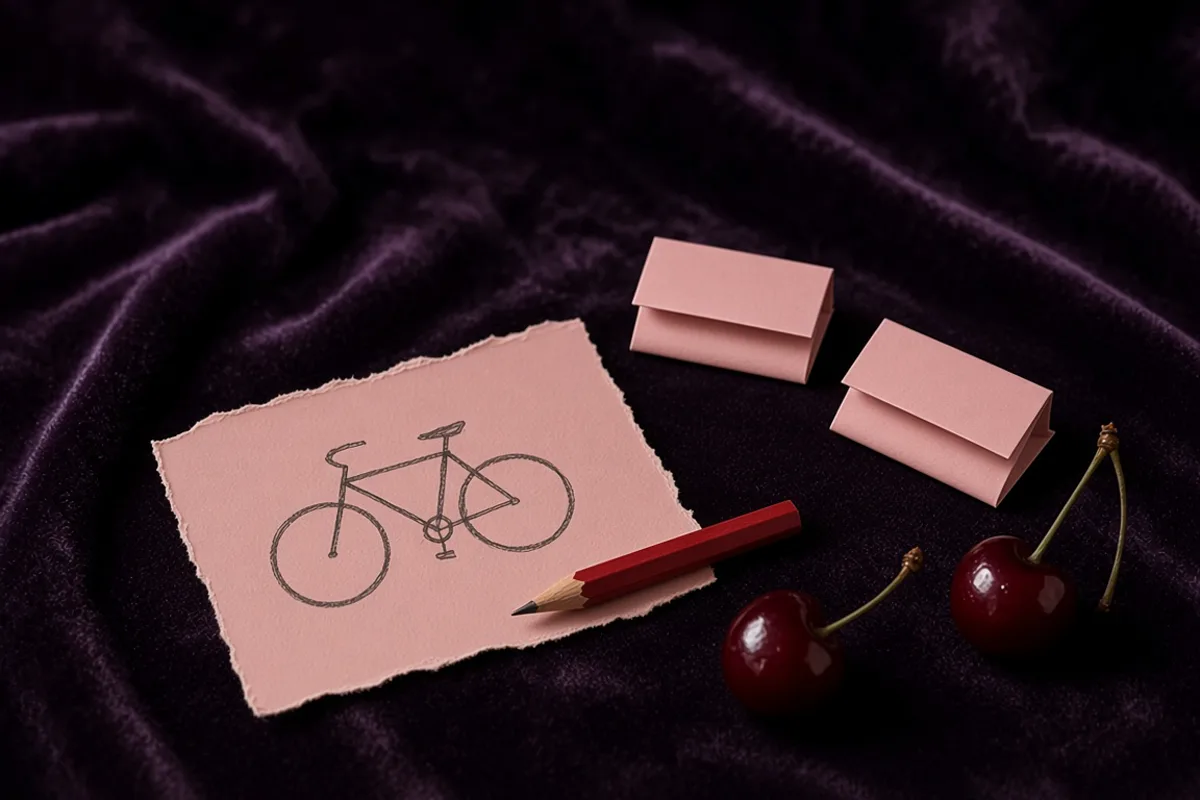
Turn 1. A draws, B guesses. Prompt: a bicycle. A draws two circles, a frame, and a seat. B says "a bicycle" with time left. That is a success. "Bike" would have counted too. The drawing did not need spokes, a road, or a rider. Swap.
Turn 2. B draws, A guesses. Prompt: making tea. B draws a cup shape and a wavy line. A says "a window?" B does not laugh at the drawing and does not argue. A says "I will pass." B says "That is fine. It was making tea." The pass is not a success and takes nothing away. Swap.
Turn 3. A draws, B guesses. Prompt: a rainy window. A draws a rectangle and a few short diagonal lines. B says "rain on a window." A says the prompt was "a rainy window." B's words already name that, so accept it. Do not debate the extra word "on."
Three sample turns are done. If you are playing a full session, take three more prompts from the list, still swapping, still on the same timer, still with the same pass. If you only wanted to see a turn, stop while it is still fun. Name one drawing you liked.
If you had turned the shared target on before turn 1, you would have one success on turn 1, a pass on turn 2, and one accepted guess on turn 3, with three turns still to play. The target does not rewrite these three results.
The sample is enough to start
Play the sample above, or continue with the prompt list. When you want a different game, use the free couples board on one phone. The age check stays on the play screen. That board is a separate game: it does not draw for you, and it has no remote mode.
Truth or dare game for couples online Play freeFourteen prompts
Fourteen is the whole bank. Cut them into slips, or read the next line only to the drawer. They are ordinary on purpose: easy objects, everyday scenes, well-known stories, and simple actions. None of them is the bicycle, the tea, or the rainy window from the sample. Skip a slip you do not want to draw. That is the pass.
Easy objects. A teacup. An umbrella. A house key. A slice of toast.
Everyday scenes. Waiting for a bus. A picnic blanket. A sink full of dishes. Two chairs and one lamp.
Well-known stories. A glass shoe on a staircase. A wolf in a nightcap. A tortoise and a hare.
Simple actions. Brushing teeth. Opening a wrapped gift. Waving from a train window.
If you write extras later, keep them guessable without being an artist. Skip anything mean, anything you would not want a friend to see, and anything that needs specialist knowledge. Do not turn this list into a long deck.
Short variations and mixed drawing skill
These stay on the same timer, the same pass, and the same stop. Agree before you use one. They do not replace the swap inside a turn you already started.
Both draw the same prompt. This is an extra round, or a replacement for the session only if you both say so before turn 1. One person reads a prompt aloud. Both draw for 60 seconds where the other cannot see. Reveal together and say what you notice. No points. A blank page is a pass. Noticing a difference is not a critique of skill.
A two-person pass-along. One chain, using the telephone-game idea with drawings. A draws the prompt for 60 seconds and hides the slip. B writes a short guess and does not say it. Hide the first drawing. A then draws B's sentence for 60 seconds without looking back at the prompt. Reveal the prompt, the first drawing, the sentence, and the second drawing. A pass at any step ends the chain. Then swap who starts, or stop. No new score.
30 seconds, or simple shapes. Before turn 1, you may shorten every turn to 30 seconds, or limit every drawing to circles, straight lines, and squares. Pick at most one of those for the whole session. The swap, the pass, and the stop stay as written.
When one person draws more easily. The job is to convey the idea, not to produce a good drawing. The timer stops a careful artist from taking a longer turn. Do not mock a scribble. Do not keep a private ranking of who is better. A disputed guess gets one sentence, then you accept it or pass. No drink, no shame, and no punishment.
If you want games that need no paper and no screen, play couples games to play at home without props. Those five games need no paper. This one uses paper, a whiteboard, or a shared screen. For a spoken choice between two options, see would you rather game for couples. For a question round with a written answer key, see couples trivia night. More guides in this language are on the articles page.
When you want a deck instead of a scribble, use the free couples truth-or-dare board on one phone. Read truth or dare game for couples online, then play free. The age check stays on the play screen. You pass one phone and pick a card. That board is a different game. It does not draw these prompts for you, and it does not open a remote room.
After drawing, one phone instead?
After the scribble session, you can switch to the free couples board on one phone. The age check stays on the play screen. That board is a separate game: it does not draw for you, and it has no remote mode. Truth or dare game for couples online
Play freeCommon questions
Can two people play without a group?
Yes. The default is one person drawing while the other guesses, then you swap. You do not need two teams. A published team game can ask for more people: the 1993 Pictionary sheet we read uses teams of two to four, and its three-player option is still two teams with one person drawing for both. This page is the two-person swap instead.
What if one person draws much better?
Draw the idea, not a finished picture. Keep the 60-second timer, or agree before turn 1 on a 30-second timer or on circles, lines, and squares only. Do not mock the drawing. A close guess is accepted when the link is clear, and a pass has no penalty. You can also count a shared target of 4 successes out of 6, instead of comparing the two people.
How many turns should we play?
Six turns, three each, or about 15 to 20 minutes, whichever comes first. That is our suggestion, not a measured ideal. The sample shows three turns so you can see a success, a pass, and a close guess. Stop earlier if you want. Either person can stop.
Can we play this on a video call?
Yes, with the same turns, timer, pass, and stop. Hold paper up to the camera, use a shared digital whiteboard, or use a browser draw-and-guess room as the drawing surface only. Ignore any score that room adds. The free board on this site is for two people passing one phone in the same room. It does not draw, and it has no remote mode. For other call games, see long-distance relationship games.
Do we need an app?
No. Paper and a pen are enough in the same room. On a call, paper held up to the camera is enough. A whiteboard or a browser room is only a surface for these rules. If it asks for an account, skip it. This site does not add a drawing canvas.